
Bahrain has a reputation among GCC healthcare professionals for being one of the more manageable licensing markets in the region. The regulator is organised, the portal is functional, and the process follows a clear sequence. But “manageable” does not mean simple, and professionals who approach it without a solid understanding of each stage still run into avoidable delays.
This guide covers everything you need: what the NHRA is, who must be licensed, the full step-by-step application process, DataFlow verification, the Prometric exam rules, official fee figures, and how renewal works. Whether you are applying for the first time or transferring an existing GCC credential, this is your 2026 reference.
What Is the NHRA and Who Regulates Healthcare in Bahrain?
The National Health Regulatory Authority (NHRA) is an independent government body established under Bahrain Law No. 38 of 2009. Its mandate is to regulate the licensing and conduct of all healthcare professionals and facilities operating in the Kingdom, across both the public and private sectors. Patient safety and professional standards are its primary accountability.
Every application, renewal, transfer, and Good Standing request for healthcare professionals is processed through NHRA’s dedicated online platform, known as MEHAN (mehan.nhra.bh). MEHAN is the single official gateway for all licensing activity — there is no parallel paper-based route for standard applications.
The NHRA’s Health Profession Regulation Section is divided by specialisation: Medical, Dental, Allied Medical, Nursing, and Pharmacy each have dedicated regulation teams. This matters because your specific profession determines which Professional Qualification Requirements (PQR) apply to your case, and by extension, what documents you need and whether you will be required to sit a licensure exam.
Understanding this structure at the outset prevents one of the most common early mistakes: applying under the wrong professional category or submitting documents calibrated to the wrong PQR criteria.
Who Needs an NHRA License Before Practicing in Bahrain?
Every healthcare professional practicing in Bahrain — Bahraini national or expatriate, public sector or private — must hold a valid NHRA license. There are no exemptions based on employer type or contract structure. Practicing without a valid license is a regulatory violation regardless of your qualifications or home country registration.
The licensing requirement covers a broad range of professions. Doctors, dentists, nurses, pharmacists, and allied health professionals are the primary categories. Allied health includes roles such as physiotherapists, radiographers, laboratory technicians, dieticians, optometrists, pharmacy technicians, respiratory technicians, and speech and audio therapists, among others. Alternative medicine practitioners are also governed under NHRA’s framework.
Visiting physicians operate under a separate licence category with its own fee structure and documentation requirements. Part-time practice and surgical privileges also require separate applications through MEHAN.
The foundational document controlling your eligibility is the Professional Qualification Requirements (PQR). The PQR specifies the minimum degree, postgraduate qualifications, and years of clinical experience required for each profession and classification level.
Before investing time in document preparation, review your specific PQR on the NHRA qualifications requirements page to confirm you meet the threshold. For general practitioners, the minimum is typically two to three years of post-qualification clinical experience. For specialists and consultants, requirements are substantially higher and often include board certifications or fellowship credentials.
What Documents Do You Need to Apply for an NHRA License?
Document preparation is the most labour-intensive part of the process, and errors or omissions here are the most common cause of application delays. Prepare everything before you open your MEHAN application — incomplete submissions stall the process and require re-uploads.
Core Document Checklist:
| Document | Key Requirement |
|---|---|
| Valid passport | Minimum one year remaining validity |
| Passport-size photograph | Recent, white background |
| Primary degree certificate | MBBS, BDS, BSN, BPharm, or equivalent — attested |
| Academic transcripts | Full mark sheets for all healthcare degrees |
| Internship/house job certificate | Confirms completion of mandatory rotational internship |
| Postgraduate qualifications | Masters, fellowship, or board certifications if applicable |
| Professional license(s) | From home country and all previous countries of practice |
| Experience certificates | From all employers covering required years of experience |
| Good Standing Certificate | Issued by the licensing authority of your last country of practice; must be dated within 6 months of application |
| Updated CV/resume | Covering full professional history |
| Job offer letter | From a licensed Bahrain facility (required to activate the final license) |
The Good Standing Certificate is worth highlighting separately. It is proof that no disciplinary action or professional misconduct record exists against you in the country where you were last registered. It must come from the relevant licensing council or authority — not from your employer — and its 6-month validity window is strict. Apply for it early, as some international councils take several weeks to issue.
How Does the NHRA Application Process Work Step by Step?
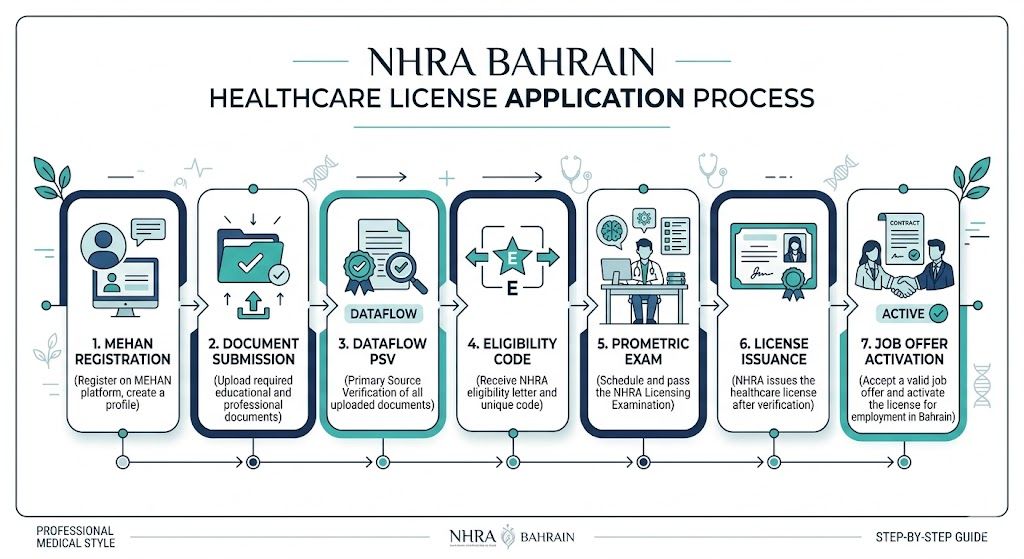
The NHRA licensing process is sequential. Skipping or reordering steps causes rejections and delays. Follow this path in order.
Step 1 — Create your MEHAN account. Register on mehan.nhra.bh and complete your professional profile. All subsequent steps in the process — application, tracking, exam registration, license activation, and renewal — happen through this account.
Step 2 — Submit your license application and documents. Upload your complete document set and submit your application. The NHRA will review your submission against the PQR for your profession. Do not submit until every document on your checklist is ready; partial submissions do not progress faster.
Step 3 — Complete DataFlow Primary Source Verification (PSV). Before NHRA approves your application, your credentials must be verified directly with their original issuing institutions. This process is handled by DataFlow Group, which has been NHRA’s exclusive PSV partner since 2017. DataFlow contacts your university, licensing boards, and employers independently to confirm the authenticity of every document you submitted. A positive DataFlow report is the essential prerequisite for the next stage.
Realistically, the PSV process takes between 20 and 45 working days. It can take longer if your university or national licensing board is slow to respond — a factor outside your control. Start your DataFlow application as early as possible and track its status through the DataFlow portal regularly.
One practical advantage many professionals overlook: if you already hold a positive DataFlow report from a previous GCC license application — DHA in Dubai, SCFHS in Saudi Arabia, QCHP in Qatar, or any other GCC authority — you can transfer that report to NHRA rather than initiating a full new verification. This saves both time and cost and is available directly through the DataFlow portal. Only DataFlow reports can be transferred between GCC authorities.
Step 4 — Receive your Eligibility Code. Once NHRA has reviewed your application and DataFlow has returned a positive PSV report, NHRA issues you a unique Eligibility Code through MEHAN. This code authorises you to register for the Prometric licensure exam. It is valid for a maximum of four months from the date of issue. If it expires before you sit the exam, you will need to request a new one — so book your exam promptly after receiving it.
Step 5 — Register and sit the Bahrain Licensure Examination (BLE) via Prometric. Using your Eligibility Code, register for your exam through Prometric’s scheduling system. The exam can be taken at a Prometric centre in Bahrain or internationally — including India, the UAE, the UK, and other major testing locations. This is a significant advantage for professionals still based in their home country who want to complete the exam before relocating.
Step 6 — NHRA issues your professional license. After you pass the exam, NHRA processes the final administrative steps and issues your license through MEHAN.
Step 7 — Activate your license with a job offer. A formal job offer from a licensed healthcare facility in Bahrain is required to activate your license for practice. You can complete steps 1 through 6 independently before securing employment, which gives you a competitive advantage when approaching Bahraini employers.
📌 Professional observation: In practice, professionals who prepare their DataFlow application in parallel with their MEHAN submission — rather than waiting for one to complete before starting the other — can shorten the overall timeline by several weeks. Both processes can run concurrently. The DataFlow report simply needs to be available before NHRA issues the Eligibility Code.
What Are the NHRA Prometric Exam Rules and Attempt Limits?

The Bahrain Licensure Examination is mandatory for the following professions: Medical Practitioners, Dental Practitioners, Nurses, and Pharmacists. Many allied health professionals are also required to sit the exam — confirm whether your specific profession is on the current list via the NHRA Licensure Exams page.
All exam applications must be submitted through NHRA, which then generates the Eligibility Code for Prometric registration. The NHRA does not accept direct exam bookings without a valid Eligibility Code.
Exam format: The seating time is 3 hours. The actual examination time is 2.5 hours. The exam is computer-based and delivered through Prometric’s standard single-best-answer MCQ format, calibrated to your specific profession and classification.
Attempt rules: You are permitted up to four consecutive attempts within a maximum of three years from the date of your first attempt. If you do not pass within four attempts, you are required to complete a minimum six-month retraining period and provide documented proof of completion before you can sit again.
Two additional attempts are then permitted within a further two-year window. This framework, established under NHRA Decision No. 11 of 2015, applies uniformly across all professions.
Preparing specifically for the NHRA format is important. The exam tests knowledge relevant to Bahrain’s healthcare standards and regulatory context, not only general clinical competence. Profession-specific Prometric preparation materials calibrated to the NHRA question structure are widely available and worth investing in.
What Are the Official NHRA License Fees in Bahrain?
This is practical information that most guides do not include. The following annual license fees are set by NHRA under the Supreme Council of Health Decision No. 17 of 2016:
| Professional Category | Annual Fee (Bahraini Dinars) |
|---|---|
| Consultant Doctor | BD 90 |
| Specialist Doctor | BD 70 |
| General Practitioner | BD 50 |
| Nurses | BD 40 |
| Allied Health Professionals | BD 40 |
| Pharmacists | BD 50 |
| Pharmacy Technicians | BD 40 |
| Medical Delegate | BD 70 |
| Visiting Consultant Physician | BD 100 per month |
All fees are annual except the visiting physician license, which is charged monthly (a partial month counts as a full month). These are the license fees only and do not include DataFlow verification fees, attestation costs, or exam registration fees, which are charged separately by the respective service providers.
At current exchange rates, annual license fees in Bahrain are among the lowest in the GCC — another factor that makes Bahrain an efficient first-entry point for professionals building a multi-country licensing portfolio.
How Do You Renew Your NHRA License and What Happens After?
License renewal is handled entirely through your MEHAN account at mehan.nhra.bh. The NHRA requires renewal applications to be submitted at least two months before your license expiry date. Do not wait until the last month — late submission risks a lapse in your legal authorisation to practice.
The renewal process involves submitting an updated application, attaching any required documents (including evidence of Continuing Professional Development where applicable), and paying the annual renewal fee through the portal.
Good Standing Certificate for onward GCC licensing: Once you hold a valid NHRA license, you can request a Certificate of Good Standing directly through your MEHAN account. This certificate is what other GCC licensing authorities — DHA, SCFHS, QCHP, OMSB — will require if you later apply for a license in another country.
Many professionals based in Bahrain leverage their proximity to Saudi Arabia via the King Fahd Causeway and pursue parallel SCFHS registration. Having a current NHRA Good Standing Certificate and an existing DataFlow report makes that pathway considerably faster to initiate.
The NHRA also covers Continuing Professional Development (CPD) requirements through its dedicated CPD section, which governs ongoing education obligations for licensed professionals.
Frequently Asked Questions About NHRA Licensing
Q1: Can I start my DataFlow application before submitting to NHRA?
Yes, and it is advisable to do so. DataFlow PSV and your NHRA MEHAN application can run concurrently. You do not need to wait for one to complete before initiating the other. Since DataFlow takes 20 to 45 working days, starting it early is the single most effective way to reduce your total application timeline.
Q2: What happens if my NHRA Eligibility Code expires before I sit the exam?
The Eligibility Code is valid for four months from its date of issue. If it expires, you will need to request a new one through your MEHAN account. Your underlying application status does not reset, but exam booking cannot proceed without an active code. Book your Prometric slot promptly after receiving the code to avoid this situation.
Q3: Can I transfer a previous GCC DataFlow report to NHRA instead of starting fresh?
Yes. If you have an existing positive DataFlow report from any GCC health authority — including DHA, SCFHS, QCHP, DOH, or OMSB — you can transfer that report to NHRA through the DataFlow portal’s Report Transfer option. This avoids paying for a full new verification and can significantly shorten the PSV phase. Only DataFlow reports are transferable between GCC authorities; reports from other PSV providers are not eligible.
Q4: How long does the full NHRA licensing process take from start to finish?
The total timeline varies by profession and individual circumstances. DataFlow PSV alone takes 20 to 45 working days as a baseline. Add NHRA credentialing review (typically 10 to 15 business days after PSV), exam scheduling and preparation time, and final license processing. A realistic total timeline for a well-prepared applicant is three to five months. Professionals with a transferable DataFlow report and straightforward documentation can expect to be at the shorter end of that range.
Q5: Can I legally work in Bahrain while my NHRA license application is pending?
No. You must hold a valid, activated NHRA license before practicing as a healthcare professional in Bahrain. Working without a license — even on a temporary or voluntary basis — is a regulatory violation. Some professionals complete most of the licensing process while still based in their home country, then relocate once the license is issued and a job offer is in hand.
Conclusion
The NHRA licensing process in Bahrain is genuinely one of the more structured and navigable routes in the GCC. The steps are clear, the portal is consolidated, and the fees are transparent. What separates a smooth application from a drawn-out one is preparation — specifically, having your documentation complete before you submit, starting DataFlow early, and understanding the Eligibility Code timeline before it becomes a bottleneck.
Bahrain also offers a strategic advantage for professionals with regional ambitions. Its proximity to Saudi Arabia, the transferability of DataFlow reports across GCC authorities, and the accessibility of its Good Standing Certificate through MEHAN make it a natural anchor for a multi-country licensing strategy.
If you are unsure about your eligibility, PQR requirements, or how your existing qualifications map to the NHRA classification system, a short consultation before you begin can prevent weeks of wasted effort.
Book a free eligibility assessment with Waqar Amin to review your documents and confirm the right approach before you apply.