
Qatar’s healthcare sector continues its remarkable expansion, creating substantial opportunities for international healthcare professionals. Following the FIFA World Cup 2022 infrastructure investments, the country maintains its commitment to healthcare excellence through world-class facilities like Hamad Medical Corporation and Sidra Medicine.
For any healthcare professional seeking to practice in Qatar, obtaining a license from the Qatar Council for Healthcare Practitioners (QCHP) is mandatory.
This comprehensive guide walks you through every step of the licensing process, from initial eligibility requirements to final license issuance, ensuring you understand the complete pathway to practicing medicine in Qatar’s thriving healthcare system.
What is QCHP License and Why You Need It
Understanding QCHP’s Role in Qatar Healthcare
The Qatar Council for Healthcare Practitioners (QCHP), operating under the Department of Healthcare Professions (DHP) within the Ministry of Public Health, serves as the sole regulatory authority responsible for licensing all healthcare practitioners in Qatar.
According to official DHP guidelines, the QCHP regulates healthcare practitioners in both governmental and private sectors, ensuring that professionals meet rigorous standards of competence and fitness to practice. The license is mandatory for doctors, nurses, pharmacists, dentists, and allied health professionals across all specialties and practice settings.
The QCHP’s primary function is to protect public health and safety by verifying that all practicing healthcare professionals possess genuine, validated credentials through a comprehensive registration and licensing system.
Benefits of QCHP License
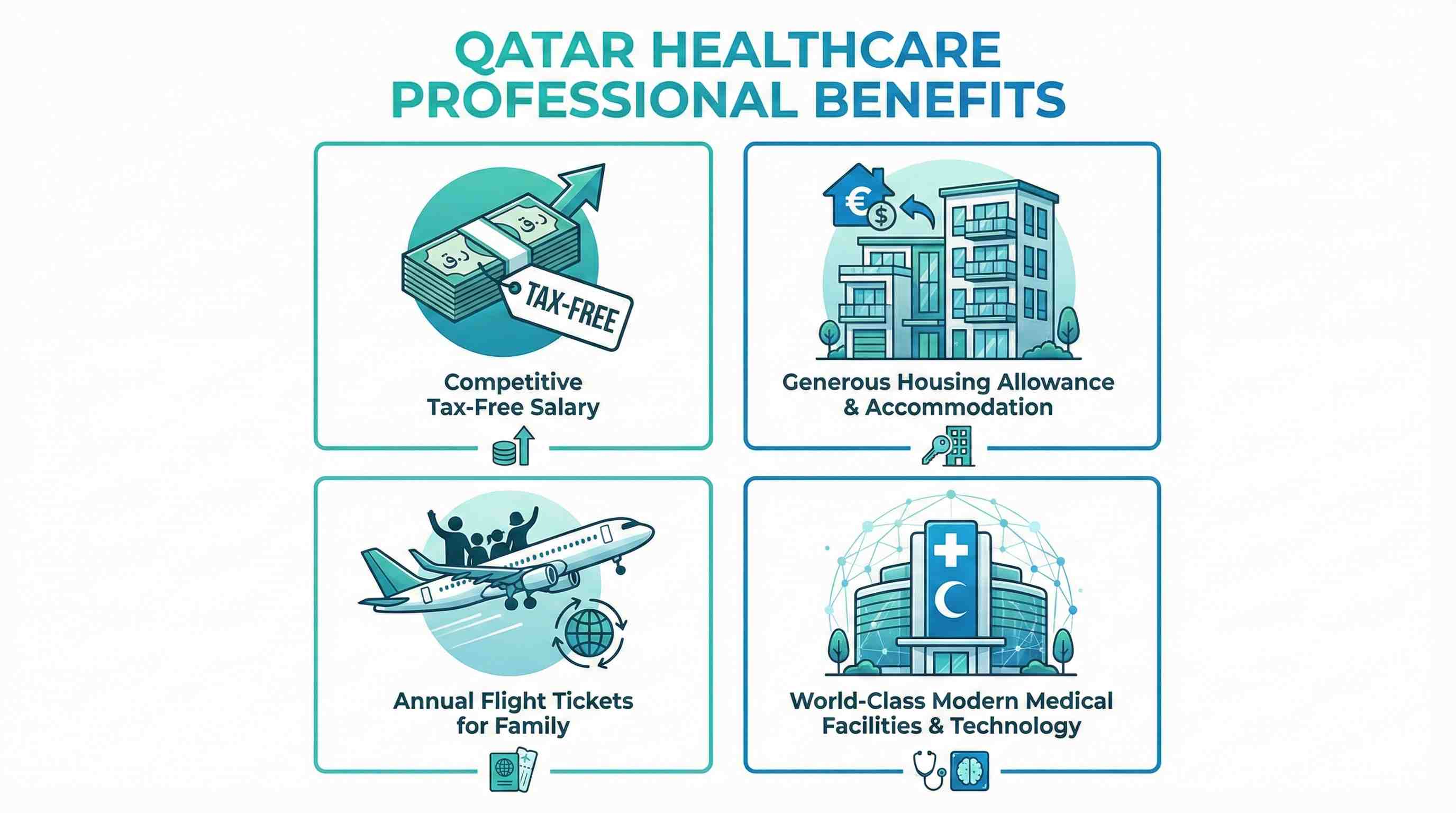
Qatar offers compelling advantages for licensed healthcare professionals. General Practitioners earn between QAR 18,000-28,000 monthly, while Specialists command QAR 30,000-50,000 per month, and Consultants earn QAR 60,000-90,000 monthly—all tax-free.
Beyond competitive salaries, healthcare professionals receive comprehensive benefits packages including housing allowances, annual flight tickets for family members, health insurance coverage, and end-of-service gratuity payments.
Working in Qatar provides access to cutting-edge medical facilities equipped with advanced technology, alongside opportunities for professional development through institutions like Weill Cornell Medicine-Qatar and Qatar Biomedical Research Institute.
Complete QCHP License Requirements by Profession
Eligibility Requirements for Doctors
Physicians must hold an MBBS or MD degree from a recognized university approved by QCHP, along with completion of a one-year internship program. Clinical experience requirements vary significantly by professional category.
General Practitioners need a minimum of two years post-registration clinical experience, while Specialists require three to five years of experience following postgraduate qualification completion in their specialty field.
The DHP maintains an approved specialty qualifications list for physicians, recognizing postgraduate degrees from institutions including Royal Colleges, American Board certifications, and equivalent international qualifications.
All physicians must provide a Good Standing Certificate from their home country medical council, covering the entire period of required experience years. According to QCHP guidelines, this certificate verifies that no pending disciplinary actions exist and confirms fitness to practice.
English proficiency is generally required, demonstrable through IELTS or TOEFL examinations, though Arabic knowledge enhances patient communication in certain clinical settings.
Requirements for Nurses
Registered nurses must possess either a General Nursing and Midwifery (GNM) diploma or a B.Sc. A nursing degree from an accredited institution, along with a valid registration certificate from their home country nursing council.
The standard requirement includes two years of clinical experience post-registration, though new graduates or nurses with less than two years of experience may complete an internship program in Qatar or demonstrate equivalent training completion from their home country.
Specialty nurses—those holding postgraduate certificates in nursing specialties with a minimum one-year full-time course duration—must additionally complete at least one year’s experience in their related specialty field post-qualification.
Requirements for Other Healthcare Professionals
Pharmacists seeking QCHP licensure need either a B.Pharm or Pharm.D degree plus two years of pharmacy experience after graduation, working in retail or clinical pharmacy settings. Dentists require a BDS or equivalent degree, completed internship, and two years of clinical experience before applying for the General Dentist examination.
Allied health professionals—including laboratory technicians, radiographers, physiotherapists, and others—must hold relevant degrees in their specialization plus experience requirements that vary by specific scope of practice.
Break from Practice Policy
The DHP maintains specific policies for practitioners who have experienced gaps in clinical practice. Breaks of less than two years are generally accepted without additional requirements. However, gaps ranging from two to five years may require supervised practice or evaluation before full licensure.
Practitioners with breaks exceeding five years typically need retraining completion—minimum six months—before becoming eligible to apply for the qualifying examination.
The 4-Step QCHP License Application Process
Step 1 – Create MOPH Portal Account
Begin by registering on the Qatar DHP-MOPH online registration system. The electronic portal requires detailed personal information, professional credentials, and a comprehensive work history.
Upload initial documentation, including passport copies, degree certificates, professional registration certificates, and preliminary qualification documents.
This account serves as your primary interface throughout the entire licensing process, where you’ll track application status and receive official communications.
Step 2 – DataFlow Primary Source Verification (PSV)

Primary Source Verification represents the most critical—and often longest—phase of QCHP licensing. The QCHP mandates that DataFlow Group and Gulf Bridge Services serve as approved providers for conducting PSV for all healthcare practitioner documents.
DataFlow contacts your educational institutions, previous employers, and licensing authorities directly to verify the authenticity of your credentials.
Documents requiring verification include your medical degree from the issuing university, internship completion certificate, work experience confirmation from all previous employers, professional registration or license from your home country medical council, and a Good Standing Certificate covering all required experience years.
According to official QCHP documentation, the primary source verification process takes a minimum of 30 working days—approximately six calendar weeks.
However, processing times typically range from 20-45 working days, depending on the responsiveness of issuing authorities. Delays commonly occur when previous employers or universities are slow to respond to verification requests.
Once issued, your DataFlow verification report remains valid for six months, providing sufficient time to complete subsequent licensing steps.
Healthcare professionals who already possess DataFlow reports from other GCC countries can utilize the Report Transfer option, receiving their new DHP-MOPH Qatar report within five days if no additional documents need verification.
Pro tip from licensing consultants: Proactively inform your previous employers and universities that DataFlow will contact them for verification. This advance notice significantly accelerates the verification timeline and reduces potential delays.
Step 3 – QCHP Prometric Exam

Upon DataFlow verification completion and positive report submission to QCHP, the authority reviews your complete application profile. If your qualifications meet all criteria, QCHP issues an “Eligibility Number”—your authorization to schedule the Prometric qualifying examination.
The computer-based examination assesses professional competency through multiple-choice questions. For doctors, the exam consists of 100 questions to be completed within 2.5 hours. Nurses face 150 questions over three hours.
The passing score is set at approximately 50-60% depending on the profession, with nurses requiring 50% minimum.
Examination fees typically range from USD 200-300, payable directly to Prometric during registration. One significant advantage: candidates can take the QCHP exam at any authorized Prometric test center worldwide, eliminating the need to travel to Qatar specifically for examination purposes.
QCHP allows up to five examination attempts, though specific professions limit attempts to three times within one calendar year. Results remain valid for three years from the examination date.
Important 2025 updates include revised examination content for pharmacists (effective May 1, 2025) and general dentists (effective June 17, 2025), requiring candidates to reference updated study materials on the DHP website.
Score reports are released immediately upon exam completion to the registered email address, allowing rapid progression to the final licensing stage.
Step 4 – License Issuance & Activation
After successfully passing the Prometric examination, QCHP conducts a final application review and issues your professional license, valid for two years from the issuance date. However, the license requires activation before legal practice can commence.
License activation necessitates securing a job offer from a licensed healthcare facility in Qatar. The employing institution acts as your sponsor, submitting the license activation request through official channels. This employment-linked activation model ensures that all practicing healthcare professionals work within regulated healthcare settings.
License renewal occurs biennially, with continuing professional development requirements. Healthcare practitioners must typically complete approximately 30 hours of accredited Continuing Medical Education (CME) or Continuing Professional Development (CPD) credits every two years to maintain active licensure status.
Professional Classification Levels in Qatar
General Practitioner (GP)
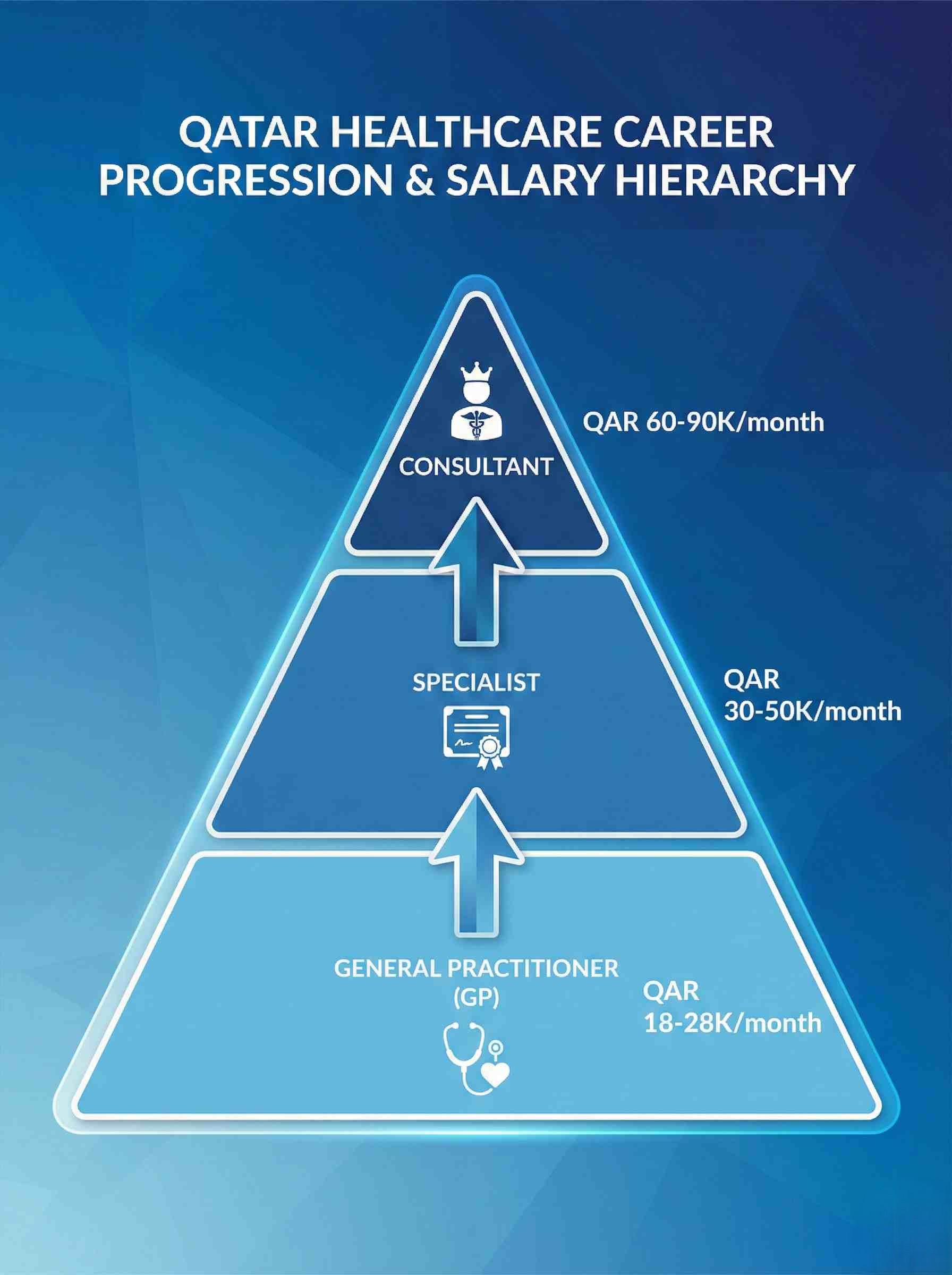
General Practitioners represent the entry-level classification for physicians, requiring an MBBS degree plus two years of post-registration clinical experience. GPs work primarily in primary healthcare centers and family clinics, providing frontline care, preventive medicine services, and specialist referrals.
The role experiences high demand across both urban and rural communities. Monthly salary ranges typically span QAR 18,000-28,000 for General Practitioners.
Specialist
Specialists hold postgraduate qualifications such as MD, MS, DNB, or recognized Diploma certifications in specific medical fields. The classification requires three to five years of post-qualification experience working in the specialty area.
Common specialty fields include Internal Medicine, Pediatrics, Obstetrics and Gynecology, Cardiology, and Surgery. Specialists work in government hospitals, private medical centers, and specialized institutes, earning monthly salaries between QAR 30,000-50,000.
Consultant
The Consultant classification represents the highest clinical level, requiring board certification from recognized institutions such as Arab Board, MRCP, MRCS, or US/Canada Board equivalents.
Consultants demonstrate extensive experience and often occupy leadership positions in tertiary hospitals and academic medical centers. This senior-most role commands monthly compensation ranging from QAR 60,000-90,000, reflecting the advanced expertise and responsibility level.
Assistant Specialty
For Qatari nationals, offspring of Qatari women, or offspring of Qatar residents holding valid family sponsorship, the Assistant Specialty classification provides a transitional pathway.
This category applies to professionals holding approved postgraduate degrees who have not yet completed the required experience years, or those who have completed experience requirements but have practice gaps requiring supervised clinical work.
Complete Document Checklist for QCHP Application
Assembling comprehensive, properly prepared documentation accelerates the licensing process significantly. Required documents include:
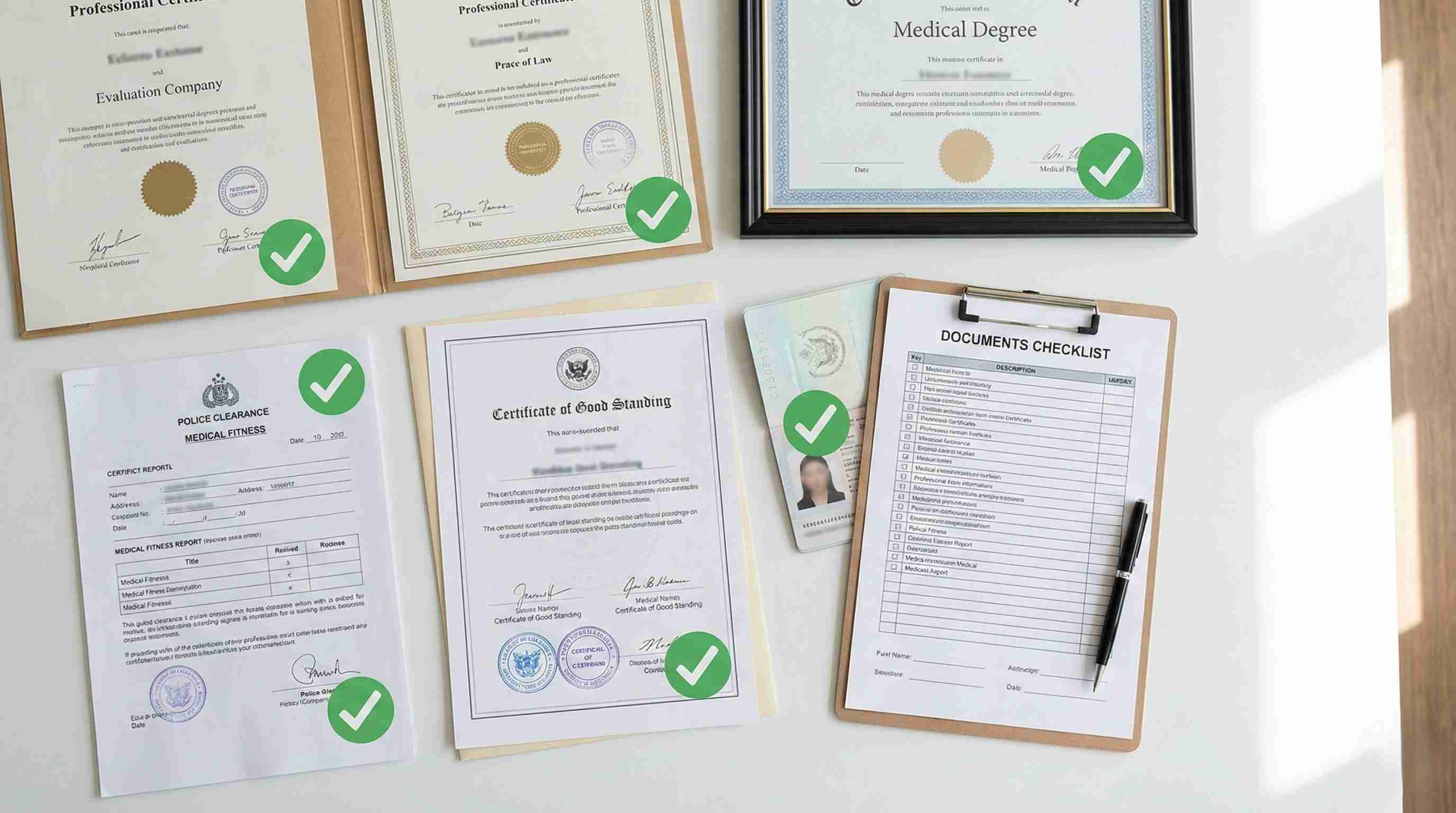
Essential Documentation:
- Valid passport with copies of all used pages
- Professional passport-size photographs (white background)
- Medical degree certificate (attested by home country and Qatar Embassy)
- Complete academic transcripts and marksheets from all educational years
- Internship completion certificate with official stamps
- Professional registration certificate from home country medical/nursing council
- Good Standing Certificate—must cover all required experience years and remain valid for six months
- Experience certificates from all previous employers covering recent 2-5 years
- Police Clearance Certificate from home country and all countries of residence within the last five years, specifically directed to Ministry of Public Health Qatar
- Medical fitness report (valid six months) including HIV test, HCV AB test, HBV Surface Ag, HBV Surface Ab, HBV Core Ab, and Chest X-Ray
- English proficiency certificate (IELTS or TOEFL scores)
- CPR (Cardiopulmonary Resuscitation) certification from recognized provider
- DataFlow PSV payment receipt and case number
Critical Document Requirements:
All documents must be in English or accompanied by certified translations. Scan all documents in high-resolution, ensuring complete legibility—poor quality scans represent a common cause of application delays.
Ensure consistent name spelling across all documents, as discrepancies trigger verification issues. According to licensing experts, checking all names and dates for consistency prevents significant delays.
Timeline and Costs Breakdown
Realistic Timeline Expectations
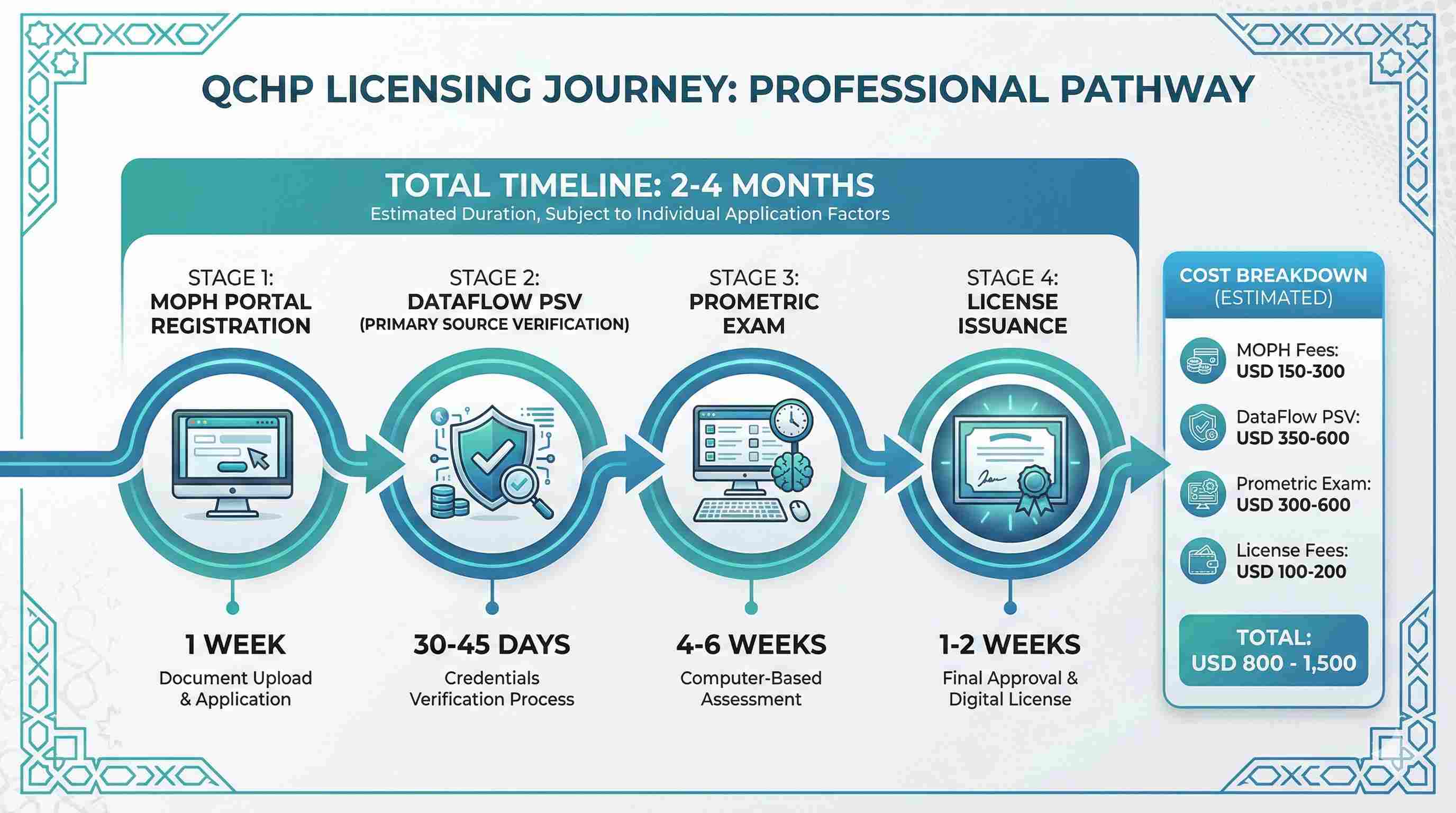
Healthcare professionals planning Qatar relocation should anticipate a comprehensive licensing timeline. DataFlow Primary Source Verification typically requires 20-45 working days, translating to approximately 30-60 calendar days depending on institutional response times. QCHP application review following DataFlow completion takes an additional 2-4 weeks.
Prometric examination scheduling requires planning—book your exam slot 4-6 weeks ahead to secure preferred dates, especially during peak application seasons. After passing the examination, license issuance typically occurs within 1-2 weeks.
The complete process from initial application to license receipt realistically spans 2-4 months, though complex cases or verification delays can extend the timeline to six months. Starting your DataFlow application early—ideally before securing a job offer—significantly reduces overall waiting time.
Complete Cost Breakdown
Budget planning for QCHP licensure requires accounting for multiple fee components. QCHP application fees vary by profession and classification level. DataFlow Primary Source Verification represents the largest single expense, typically ranging from USD 150-400, depending on the number of documents requiring verification.
Additional costs vary based on applicant circumstances: graduates from certain countries require extra certificates to be verified, increasing PSV fees. Healthcare professionals transferring existing DataFlow reports from other GCC countries pay approximately QAR 200 for report transfer processing.
Prometric examination fees run USD 200-300, depending on the profession type. Document attestation through home country authorities and the Qatar Embassy typically costs USD 100-300. Medical fitness testing requires QAR 200-400 for the comprehensive panel. Police clearance certificates involve variable costs depending on the issuing country’s procedures.
Healthcare professionals should budget an estimated total of USD 800-1,500 for the complete QCHP licensing process, excluding travel expenses if examination or attestation requires international movement.
QCHP vs Other GCC Licenses – Quick Comparison
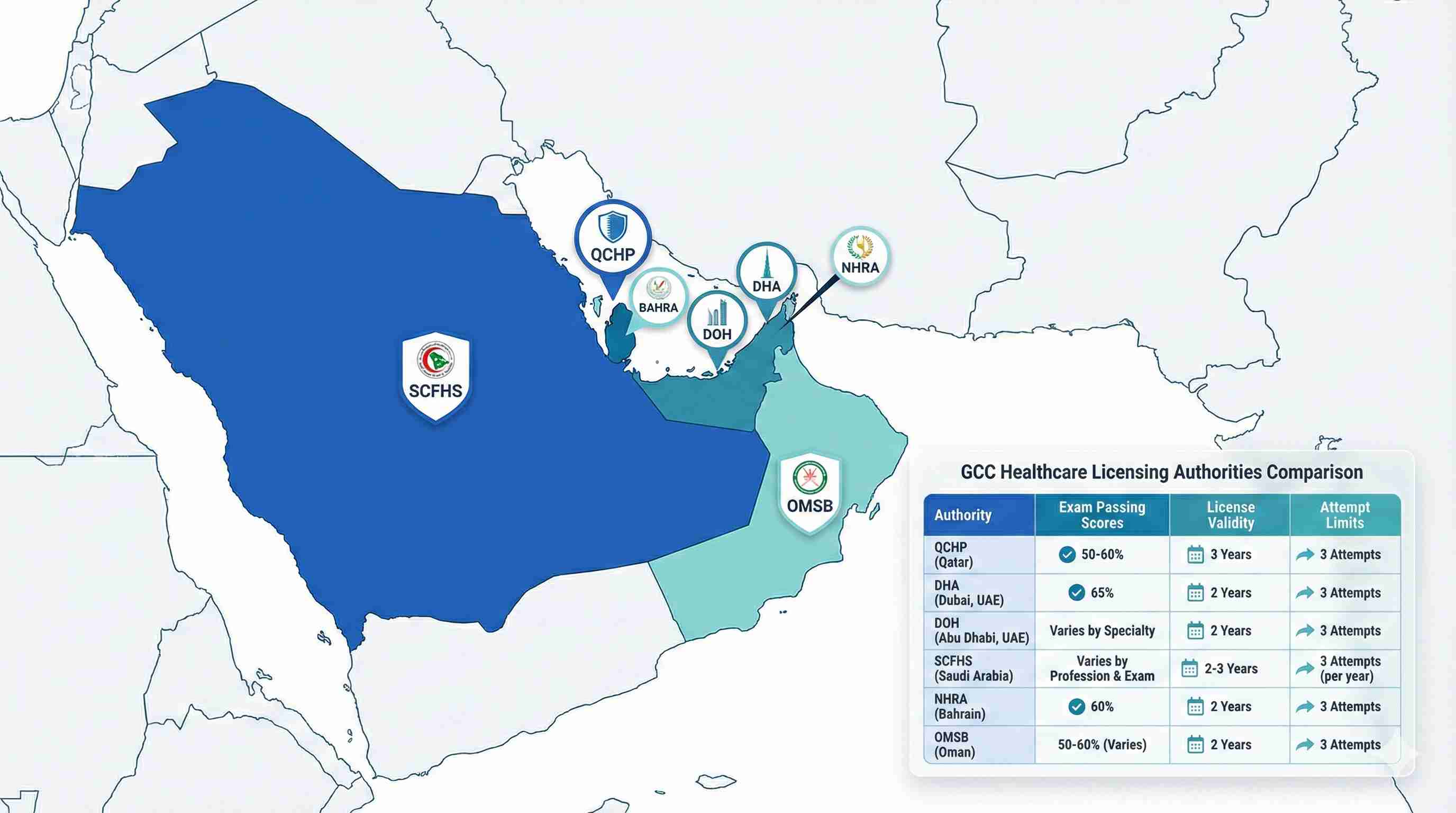
QCHP (Qatar) vs DHA (Dubai)
Both licensing authorities require DataFlow Primary Source Verification and Prometric examination completion, with similar overall timelines spanning 2-4 months.
However, key differences exist: the DHA (Dubai Health Authority) license applies only to Dubai emirate healthcare practice, separate from Abu Dhabi’s Department of Health or the federal Ministry of Health licensing.
Examination standards differ notably—DHA requires a 65% passing score compared to QCHP’s 50-60% threshold. DHA permits a maximum of three examination attempts, while QCHP allows up to five attempts. Both systems offer provisional or supervised practice licenses under specific circumstances.
QCHP vs SCFHS (Saudi Arabia)
Saudi Arabia’s licensing system through the Saudi Commission for Health Specialties (SCFHS) operates distinctly from Qatar’s framework. SCFHS utilizes the Mumaris Plus electronic system for professional classification and registration. The Saudi system implements a five-year registration cycle, contrasting with QCHP’s two-year license validity.
Continuing education requirements prove substantially higher in Saudi Arabia—Consultants may require up to 250 CME hours over five years, compared to Qatar’s approximately 30 hours biennially. Both authorities emphasize Western training and Board certifications for specialist and consultant classifications. Saudi Arabia requires passing the Saudi Licensing Examination (SLE) specific to the Kingdom’s healthcare standards.
QCHP vs NHRA (Bahrain) & OMSB (Oman)
Bahrain’s National Health Regulatory Authority (NHRA) maintains a two-year renewal cycle similar to QCHP, with comparable structural requirements. Oman’s Oman Medical Specialty Board (OMSB) implements country-specific requirements while following similar PSV and examination frameworks.
Critical understanding: Each GCC country maintains a completely separate licensing system. A QCHP license remains valid only for Qatar healthcare practice and cannot be transferred to other Gulf nations without submitting entirely new applications.
However, possessing an active GCC license can streamline subsequent applications in other countries, as you can request Good Standing Certificates and potentially leverage existing DataFlow reports through the transfer mechanism.
Common Mistakes to Avoid
Document-Related Errors
Incomplete Good Standing Certificates represent a frequent application rejection cause—the certificate must cover all required experience years explicitly. Missing employer signatures or official stamps on experience letters trigger verification failures. Poor quality document scans resulting in illegible text cause significant processing delays.
Name inconsistencies across different documents create verification obstacles, as authentication systems flag discrepancies for manual review. Expired medical fitness reports or police clearance certificates—both valid only six months—require renewal if application processing extends beyond the validity periods.
Application Process Mistakes
Many applicants underestimate DataFlow processing time, failing to initiate PSV early enough. This single oversight commonly causes entire licensing timelines to extend by 6-8 weeks. Not informing previous employers and universities about incoming DataFlow verification requests results in delayed or missed responses.
Missing application deadlines, entering incorrect information on the MOPH portal, and failing to track application status regularly through the electronic system all contribute to unnecessary delays. Healthcare professionals should log into their portal accounts weekly to monitor status updates and respond promptly to any additional documentation requests.
Exam Preparation Errors
Underestimating examination difficulty represents a common miscalculation. The QCHP Prometric exam assesses professional competency comprehensively—adequate preparation time proves essential. Not booking examination slots 4-6 weeks in advance may result in no available appointments during desired timeframes, particularly during peak seasons.
Arriving late to Prometric testing centers, forgetting required identification documents, or failing to review profession-specific syllabus and examination content updates (particularly the 2025 updates for pharmacists and dentists) all jeopardize examination success.
Post-License Mistakes
Allowing licenses to expire without timely renewal submission creates practice interruptions. License renewal requires documented CME/CPD completion—healthcare professionals must maintain organized records of continuing education activities throughout the license period.
Practicing without employer license activation constitutes illegal practice, exposing practitioners to serious regulatory consequences.
How Waqar Amin Can Help You Navigate QCHP Licensing

Healthcare licensing across the Middle East involves complex regulatory frameworks requiring specialized expertise. Waqar Amin brings over seven years of experience guiding healthcare professionals and institutions through QCHP licensing processes with proven success.
Professional consultation services include comprehensive application guidance, ensuring document preparation meets exact QCHP specifications. DataFlow coordination support involves liaising with verification providers, tracking case progress, and expediting response times from educational institutions and previous employers.
Prometric examination scheduling assistance ensures strategic test center selection and optimal timing. Timeline management expertise helps healthcare professionals coordinate job offers with licensing completion, preventing costly delays. Professional classification consultation clarifies which category you qualify for based on your credentials and experience.
The consultancy maintains current knowledge of 2025 regulatory updates and requirement changes, ensuring your application reflects the latest DHP policies. As a one-stop solution for Qatar healthcare licensing, the service provides clear communication throughout the process, managing expectations realistically while pursuing efficient processing.
For healthcare professionals seeking comprehensive support from initial eligibility assessment through final license activation, expert consultation services significantly reduce stress and accelerate timeline completion while ensuring full regulatory compliance.
Frequently Asked Questions
Q1: How long does the entire QCHP licensing process take from start to finish?
The complete QCHP licensing timeline typically spans 2-4 months from initial application to license issuance, according to official processing data.
This timeline breaks down into distinct phases: DataFlow Primary Source Verification requires 20-45 working days minimum, QCHP application review takes 2-4 weeks following DataFlow completion, Prometric exam scheduling and completion adds 4-6 weeks, and final license issuance occurs within 1-2 weeks after passing the examination. However, the timeline can extend to six months if verification delays occur, examination attempts require repetition, or documentation issues arise.
Starting your DataFlow application before securing a job offer significantly reduces waiting time. Healthcare professionals should plan conservatively, allowing 4-6 months between initiating the process and anticipated practice start dates.
Q2: Can I take the QCHP Prometric exam outside Qatar, or must I travel to Doha?
The QCHP Prometric examination is available at authorized Prometric test centers worldwide, eliminating the requirement to travel to Qatar specifically for examination purposes.
Once you receive your Eligibility Number from QCHP, you can visit the Prometric website, select your test sponsor (QCHP – Qatar Council for Healthcare Practitioners), choose your specific exam category, and then select any authorized test center globally. Popular locations include major cities in India, Pakistan, the Philippines, Egypt, the UK, the US, and throughout the Middle East.
This flexibility allows healthcare professionals to complete examination requirements while remaining in their home countries, only relocating to Qatar after securing both license approval and employment offers.
After passing, travel to Qatar becomes necessary only for employment commencement and license activation with your sponsoring healthcare facility.
Q3: What happens if DataFlow cannot verify one of my documents?
If DataFlow encounters difficulty obtaining verification responses from your educational institution, previous employer, or licensing authority, they will notify you directly via email to your registered contact address.
According to verification specialists, common causes include institutions not responding to verification requests, changed contact information for employers, or merged/closed institutions. In such situations, you may need to provide alternative documentation, contact the institution directly to expedite their response to DataFlow, or supply additional proof of credentials.
Some issuing authorities charge separate fees for verification services—for example, specific universities require payment directly to them for document verification processing. In cases where institutions genuinely cannot be contacted (permanently closed universities, for instance), QCHP may accept alternative verification methods or require you to complete additional assessments.
Proactively informing all relevant institutions about incoming DataFlow verification requests before applying significantly reduces these complications.
Q4: Do I need Arabic language skills to work as a healthcare professional in Qatar?
English serves as the primary language in Qatar’s healthcare facilities, making Arabic language skills generally not mandatory for medical practice.
According to employment data, hospitals and clinics operate predominantly in English, with medical records, prescription writing, and professional communication conducted in English.
English proficiency is actually a formal requirement, typically demonstrated through IELTS or TOEFL examinations. However, Arabic language knowledge provides significant advantages in patient care settings, particularly when treating Arabic-speaking patients who may feel more comfortable discussing sensitive health matters in their native language.
Many healthcare facilities employ Arabic-speaking staff members who can provide interpretation services when needed. For healthcare professionals planning long-term careers in Qatar, learning basic medical Arabic phrases enhances patient relationships and demonstrates cultural respect, though it remains optional rather than obligatory for licensure or practice.
Q5: Can I transfer my QCHP license to practice in other GCC countries like the UAE or Saudi Arabia?
No, QCHP licenses are valid exclusively for healthcare practice in Qatar and do not transfer automatically to other Gulf Cooperation Council countries.
Each GCC nation maintains a completely independent licensing system with separate regulatory authorities: UAE has DHA (Dubai), DOH (Abu Dhabi), and MOHAP, Saudi Arabia operates SCFHS, Bahrain has NHRA, and Oman uses OMSB.
To practice in another GCC country, you must submit an entirely new license application to that country’s specific regulatory authority. However, holding an active QCHP license can streamline subsequent GCC applications in several ways: you can request a Good Standing Certificate from QCHP to submit to other authorities, your existing DataFlow report may be transferable to other GCC countries through the Report Transfer service (typically completed within five days if no additional verification is required), and some authorities may consider your GCC experience favorably during classification processes.
Nevertheless, you’ll still need to complete the new country’s examination requirements and meet its specific credential standards. Plan to invest 2-4 months for each additional GCC license acquisition.
Conclusion
Obtaining your QCHP license represents a structured, achievable goal when approached with proper preparation and expert guidance. The process encompasses four distinct phases—MOPH portal registration, DataFlow Primary Source Verification, Prometric examination completion, and final license issuance—each requiring specific documentation and timeline allocation.
Understanding professional classification levels helps you position yourself correctly based on your qualifications, while comprehensive document preparation prevents common delays that extend processing timeframes.
Qatar’s healthcare sector offers exceptional opportunities for international healthcare professionals: tax-free salaries ranging from QAR 18,000 for General Practitioners to QAR 90,000 for Consultants, comprehensive benefits packages, modern medical facilities, and clear pathways for professional advancement.
The country’s continued investment in healthcare infrastructure, research institutions, and postgraduate training programs positions Qatar as a premier destination for medical career development in the Gulf region.
With realistic timeline expectations of 2-4 months and budget planning for approximately USD 800-1,500 in licensing costs, healthcare professionals can strategically plan their Qatar relocation. Starting your application early—particularly initiating DataFlow verification before securing employment—significantly reduces waiting periods and accelerates your path to practice.
Professional licensing support from experienced consultants who understand QCHP’s specific requirements, maintain relationships with verification providers, and stay current with regulatory updates transforms a complex bureaucratic process into a manageable journey. Whether you’re a physician, nurse, pharmacist, dentist, or allied health professional, expert guidance ensures compliance with all requirements while optimizing your timeline for successful licensure completion.
Begin your QCHP licensing journey with confidence, knowing that with proper preparation and professional support, you’ll soon join Qatar’s thriving healthcare community, contributing to the nation’s vision of regional healthcare excellence.