
Saudi Arabia’s healthcare sector is experiencing remarkable growth. In 2025 alone, the Saudi Commission for Health Specialties admitted 8,298 healthcare trainees across 62 training programs in human medicine, dentistry, pharmacy, nursing, and applied medical sciences.
This expansion reflects the Kingdom’s commitment to building world-class healthcare infrastructure, creating unprecedented opportunities for international healthcare professionals seeking to practice in the Middle East’s largest healthcare market.
For international doctors, nurses, pharmacists, and allied health professionals, obtaining an SCFHS license is the mandatory gateway to practice anywhere in Saudi Arabia.
Unlike the UAE’s fragmented licensing system where Dubai (DHA), Abu Dhabi (DOH), and the northern emirates (MOH) each require separate licenses, Saudi Arabia operates a centralized licensing model through the Saudi Commission for Health Specialties.
This means one license grants you practice rights across the entire Kingdom, from Riyadh to Jeddah to Dammam.
This guide provides a complete roadmap to obtaining your SCFHS license in 2026, covering every stage from initial application to final license issuance. You’ll learn the exact process, timeline expectations, cost breakdowns, and expert strategies to navigate the system efficiently.
What is SCFHS and Why Does It Matter?
The Saudi Commission for Health Specialties is the sole regulatory authority governing all healthcare professionals in Saudi Arabia. Established in 1992 by Royal Decree M/2, SCFHS is responsible for setting standards for health practice, supervising training programs, administering licensing examinations, and issuing professional credentials.
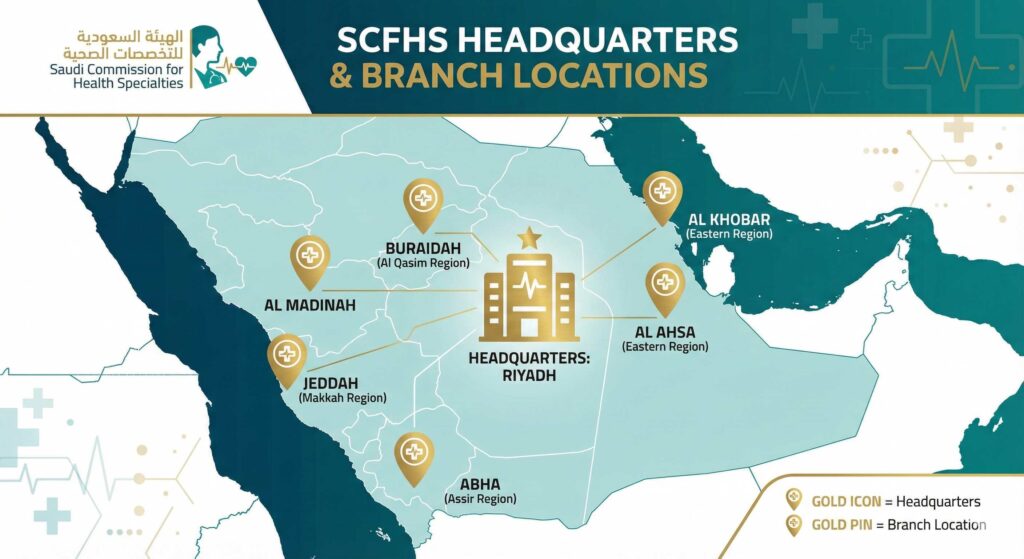
The commission’s headquarters is located in Riyadh’s Diplomatic Quarter, with six regional branches in Jeddah, Al Khobar, Al Ahsa, Abha, Al Madinah, and Buraidah ensuring nationwide coverage.
SCFHS operates through a sophisticated online system called Mumaris Plus, which manages all professional classification, registration, and licensing services.
The commission’s centralized approach means healthcare professionals don’t need multiple licenses to practice across different regions, a significant advantage compared to other GCC countries. Understanding how SCFHS defines professional classification and registration is crucial before you begin your application.
Understanding SCFHS Professional Classification vs Registration
Many applicants confuse these two distinct processes, but understanding the difference is crucial for planning your timeline accurately.
Professional Classification – The Foundation
Professional Classification is the first legal step in the licensing journey. SCFHS defines classification as the process of determining your professional title and grade based on your academic qualifications and clinical experience.
During classification, SCFHS evaluates your credentials and assigns you to a specific professional category such as Technician, Specialist, Senior Specialist, or Consultant.
Professional Classification is valid for one year, specifically for registration purposes. The Service Level Agreement for classification decisions ranges from seven working days for direct approvals to 35 working days for applications requiring practical evaluation.
If your classification period exceeds one year, you must apply for reclassification before proceeding to professional registration. The classification fee is SAR 200 for most healthcare professionals, making it one of the more affordable stages in the licensing process.
Professional Registration – Your Practice License
Professional Registration comes after classification and represents your official license to practice healthcare in Saudi Arabia. Registration requires a valid Iqama, which is Saudi Arabia’s residency permit, typically sponsored by your employer.
Without an Iqama showing “authorized to work” status, you cannot complete the registration stage even if you’ve passed all other requirements.
Professional Registration is valid for two years from the date of issuance and must be renewed through the Mumaris Plus portal before expiry. The registration process involves paying three separate fees totaling SAR 1,140: a service fee of SAR 900, an administrative fee of SAR 100, and a registration service fee of SAR 140.
Registration legally authorizes you to practice your healthcare profession within the Kingdom, making it the final and most important credential you’ll receive.
The Complete SCFHS Licensing Process: 5 Essential Stages
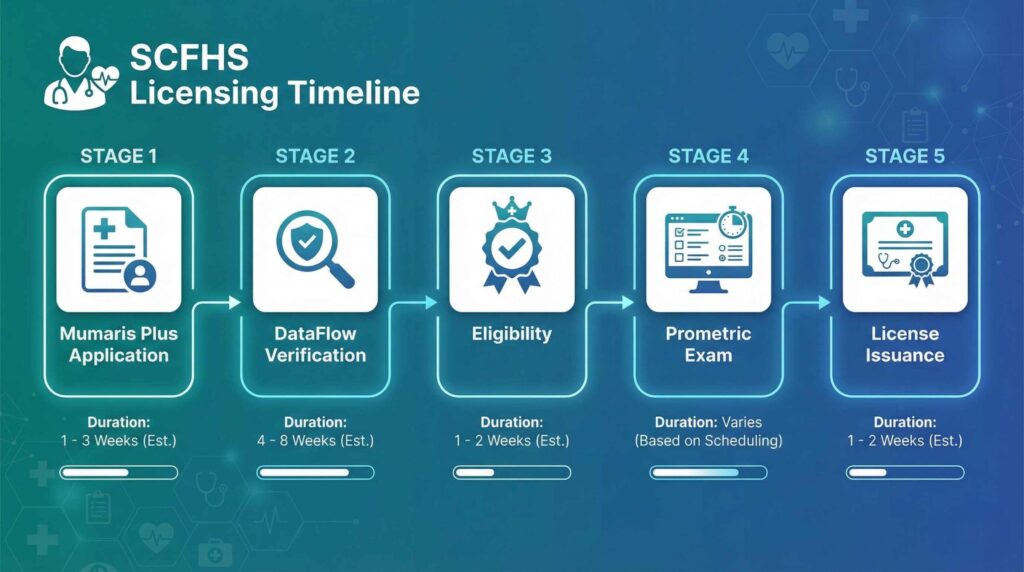
The path to your SCFHS license follows five sequential stages. Each stage must be completed successfully before advancing to the next, making it essential to understand the requirements and timeline for each phase.
Stage 1 – Mumaris Plus Account Creation and Initial Application
Your licensing journey begins on the Mumaris Plus portal, SCFHS’s centralized online platform for all professional services. You’ll create an account using your email address and passport details, ensuring your name appears exactly as it does on your passport to avoid discrepancies later.
After account activation, you’ll select the Professional Classification service and choose your healthcare profession and desired classification level based on your qualifications.
The initial application requires uploading clear scans of essential documents including your passport, academic qualifications with transcripts, internship completion certificates, professional registration certificate from your home country, and experience letters proving at least one year of post-qualification clinical practice for non-Saudi applicants.
Each document must be high-quality and legible because poor scans are a leading cause of application delays. After document submission and payment of the SAR 200 classification fee, SCFHS conducts an initial review taking seven to fourteen days to determine if your qualifications meet their requirements.
Stage 2 – DataFlow Primary Source Verification (PSV)
Once SCFHS approves your initial application, they automatically create a case with DataFlow Group, the independent verification company contracted to authenticate your credentials. DataFlow has been SCFHS’s trusted verification partner since 2008, conducting Primary Source Verification for healthcare professionals worldwide.
You’ll receive an email from Mumaris Plus containing a link to begin your DataFlow application. After creating a DataFlow account and confirming which documents require verification—typically your degree, professional license, and employment history—you’ll pay the verification fee ranging from SAR 400 to SAR 900 depending on the number of documents being verified.
DataFlow then contacts your universities, licensing bodies, and previous employers directly to confirm that every credential you submitted is genuine and accurately represents your qualifications.
DataFlow Primary Source Verification typically takes 30 to 60 working days for SCFHS applicants, though the timeline can extend to several months if your issuing institutions are slow to respond to verification requests.
This is often the longest single stage in the entire licensing process, which is why experienced applicants start their DataFlow verification at least six months before their planned employment start date. You can track your verification progress in real-time through the DataFlow portal using your unique case number.
Stage 3 – SCFHS Eligibility Approval and Exam Scheduling
After receiving your positive DataFlow report, SCFHS reviews your verified credentials and issues an eligibility number if you meet their classification requirements. This eligibility number is your official permission to schedule the Prometric licensing examination and is valid for three months from the date of issuance.
You have three attempts to pass the exam using a single eligibility number, after which you must apply to SCFHS for eligibility reactivation if you need additional attempts.
With your eligibility number in hand, you’ll visit the Prometric website to schedule your exam. Prometric operates testing centers in major cities worldwide including locations throughout Saudi Arabia, the UAE, India, the Philippines, the United Kingdom, and the United States, allowing you to take your exam close to home.
The exam fee is approximately $220 to $250 USD depending on your testing location. Strategic candidates book their exam date two to three months after receiving eligibility, allowing adequate preparation time while staying within the three-month validity window.
Stage 4 – Prometric Licensing Examination
The SCFHS licensing examination is a computer-based test assessing your clinical knowledge and decision-making abilities in your specific healthcare specialty. The exam consists of 200 multiple-choice questions administered over 4.5 hours, divided into two sections of 100 questions each with a 30-minute break between sections.
As of March 2023, the exam duration for Saudi Licensure Examinations including SPLE, SMLE, and SDLE was standardized to four hours and thirty minutes to ensure adequate time for thoughtful responses.
The exam format tests both theoretical knowledge and practical application through clinical scenarios, differential diagnoses, treatment protocols, and evidence-based decision-making.
The passing score is 500 points out of 800, which translates to correctly answering approximately 62.5% of questions. Exam results are posted to your Mumaris Plus portal within seven to ten working days for most specialties, though SLE title results may take two to six weeks depending on the complexity of scoring procedures for your specific examination category.
Stage 5 – Final Registration and License Issuance
Passing your Prometric exam triggers the final stage of the licensing process. You’ll return to your Mumaris Plus account to upload proof of your passing score and initiate the Professional Registration application.
This stage requires payment of the SAR 1,140 registration fee covering the service charge, administrative processing, and registration issuance. You must also provide proof of a valid Iqama with “authorized to work” status, which typically means you’ve already secured employment with a Saudi healthcare facility willing to sponsor your residency.
SCFHS conducts a final review of your complete application file, verifying that all requirements have been met including classification approval, positive DataFlow report, passing exam score, and valid residency status.
This final review typically takes seven to fourteen working days. Once approved, your Professional Registration Certificate becomes available for download through the Mumaris Plus portal. This certificate is valid for two years and serves as your official license to practice healthcare throughout Saudi Arabia, granting you the legal authority to treat patients in hospitals, clinics, or any other healthcare setting within the Kingdom.
Required Documents for SCFHS Licensing
Gathering your documentation before beginning the application saves considerable time and prevents delays.
You’ll need your valid passport or Iqama showing clear identification pages, all academic qualifications including your bachelor’s degree and any postgraduate certificates such as master’s degrees, fellowships, or board certifications depending on your desired classification level.
Academic transcripts showing your complete educational history, course duration, and clinical training descriptions are mandatory for SCFHS to evaluate your qualifications accurately.
Your internship or clinical training completion certificate must show program details including duration, enrollment date, and completion date. A professional registration certificate or license from your home country issued by the relevant medical board or health authority is required, and if your country doesn’t have a professional registration authority, you’ll need an official letter from your Ministry of Health confirming this fact.
Experience letters from all employers since graduation must be on official letterhead, show your job title, employment dates, specialty practiced, and be signed by authorized personnel such as the HR director or medical director.
A Certificate of Good Standing from your most recent licensing authority proves you’re in good standing with no disciplinary actions or malpractice claims. This certificate must be valid for at least six months from your application date and is one of the most frequently requested documents throughout the process.
All documents issued outside Saudi Arabia require verification through DataFlow’s Primary Source Verification process before SCFHS will accept them as valid credentials. Documents in languages other than English must be professionally translated and the translations verified through DataFlow alongside the original documents.
Cost Breakdown: Total Investment for SCFHS License
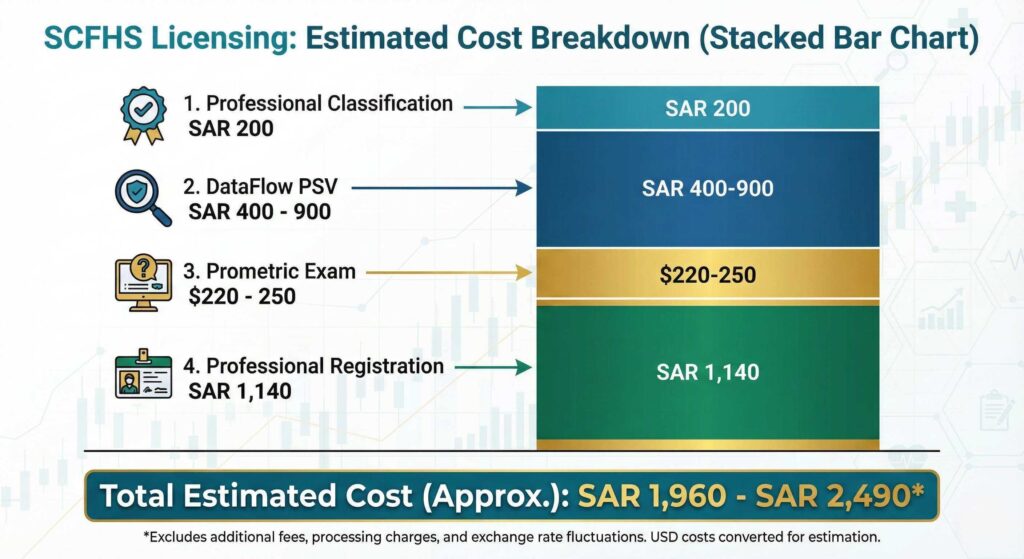
Understanding the complete financial investment helps you budget appropriately for the licensing process. The Professional Classification fee is SAR 200 (approximately $53 USD) for most healthcare categories including physicians at specialist and senior specialist levels, though consultant-level classifications may have higher fees.
DataFlow Primary Source Verification costs between SAR 400 and SAR 900 (approximately $107 to $240 USD) depending on how many documents require verification, with most applicants paying around SAR 600 for verification of their degree, license, and employment history.
The Prometric examination fee ranges from $220 to $250 USD depending on your testing location, with international test centers often charging at the higher end of this range. If you fail your first attempt and need to retake the exam, you’ll pay the full exam fee again for each subsequent attempt, making thorough preparation for your first attempt financially prudent.
Professional Registration costs SAR 1,140 (approximately $304 USD) combining the service fee, administrative fee, and registration issuance fee into a single payment during the final stage.
The total cost for obtaining an SCFHS license ranges from $680 to $850 USD covering all mandatory stages from initial classification through final registration. This investment doesn’t include optional services such as DataFlow’s VIP assistance program, professional licensing consultants, or exam preparation courses, which can add several hundred dollars to your total expenses if you choose to use them.
However, the investment is significantly lower than comparable licensing costs in Western countries and represents excellent value considering it grants you practice rights throughout the entire Kingdom of Saudi Arabia.
Timeline Expectations: How Long Does SCFHS Licensing Take?
Realistic timeline planning is essential for coordinating your licensing process with job offers and relocation plans. DataFlow Primary Source Verification is typically the longest single stage, taking 30 to 60 working days for straightforward cases where universities and employers respond promptly to verification requests.
However, if your issuing institutions are slow to respond or located in countries where communication is challenging, DataFlow verification can extend to three or even four months, making early application critical for meeting your employment start date.
SCFHS classification approval following DataFlow completion takes seven to 35 working days depending on whether your application receives direct approval or requires additional evaluation such as practical assessments or specialty-specific reviews.
Exam scheduling and preparation typically spans one to three months because most candidates need adequate study time to prepare thoroughly for the comprehensive Prometric examination, and test center availability varies by location with popular centers booking several weeks in advance.
Exam results are posted within seven to ten working days for most specialties, followed by final registration processing taking another seven to fourteen working days once you’ve uploaded your passing score and paid registration fees.
Most healthcare professionals complete the SCFHS licensing process in six to ten months from initial Mumaris Plus application to receiving their downloadable Professional Registration Certificate. However, this timeline assumes efficient document preparation, prompt DataFlow verification, passing the Prometric exam on the first attempt, and having an Iqama ready for final registration.
Delays at any stage can extend the total timeline to twelve months or longer, which is why experienced applicants begin the process at least eight months before their desired employment start date to build in buffer time for unexpected complications.
SCFHS vs Other GCC Licensing Authorities
Understanding how SCFHS compares to other Gulf healthcare licensing authorities helps international professionals make informed career decisions about where to pursue practice opportunities.
Key Differences from DHA Dubai
SCFHS provides kingdom-wide practice rights throughout Saudi Arabia’s 13 provinces, while DHA licenses are valid only within Dubai emirate and cannot be used in Abu Dhabi or other UAE regions without additional licensing.
The SCFHS licensing timeline of six to ten months is significantly longer than DHA’s three to six month process, primarily because Saudi Arabia’s DataFlow verification tends to be more thorough and classification requirements more stringent than DHA’s evaluation procedures.
SCFHS offers examination waivers for highly qualified consultants who completed their training in recognized Western countries including the United Kingdom, Ireland, France, the United States, Canada, and Australia, potentially eliminating the exam stage entirely for eligible applicants. In contrast, DHA requires mandatory examinations for almost all categories with only extremely rare exemptions for exceptional consultants with extensive experience.
Both authorities use Prometric for exam administration and DataFlow for credential verification, making the application infrastructure similar despite the organizational differences between the two regulatory bodies.
Comparison with MOH UAE
SCFHS serves as the single licensing authority for all Saudi Arabia, while MOH UAE covers only five northern emirates including Sharjah, Ajman, Ras Al Khaimah, Fujairah, and Umm Al Quwain, requiring separate licenses for Dubai or Abu Dhabi. Both authorities mandate Prometric examinations for most healthcare professionals, though SCFHS exam content is tailored to Saudi medical protocols while MOH exams focus on UAE healthcare standards and regulations.
SCFHS Professional Registration is valid for two years compared to MOH’s one to two year validity depending on professional category, meaning Saudi licenses require less frequent renewal administrative effort.
The cost structures are comparable with both authorities charging similar amounts for classification, verification, examinations, and registration when converted to equivalent currencies.
However, SCFHS’s centralized model means professionals can work anywhere in Saudi Arabia immediately upon licensure, while MOH professionals are restricted to the five northern emirates and must obtain additional licenses to practice in Dubai or Abu Dhabi, creating potential career limitations for those seeking broader geographic mobility within the GCC region.
Who Is Exempt from the SCFHS Prometric Exam?
While most healthcare professionals must pass the Prometric licensing examination, SCFHS grants examination exemptions to highly qualified consultants who completed their medical training and specialty programs in countries with healthcare systems recognized by Saudi Arabia for excellence.
Specifically, physicians, dentists, and specialists who obtained their qualifications from the United Kingdom, Ireland, France, the United States, Canada, Australia, or Saudi Arabia itself may qualify for exam waivers depending on their credentials and experience level.
Exemption eligibility typically requires consultant-level qualifications such as fellowship certifications from prestigious medical colleges, combined with substantial post-qualification clinical experience, usually five to ten years practicing at the consultant level.
Saudi nationals who completed their training in recognized programs within the Kingdom are often exempt from examinations as well.
However, exemptions are evaluated case-by-case and remain relatively rare exceptions rather than standard procedure, with the vast majority of international healthcare professionals required to demonstrate their clinical competency through successful Prometric examination performance regardless of their training origin or experience level.
Common Challenges and How to Overcome Them
Name discrepancies across documents represent the single most common reason for application delays and rejections. If your passport shows “Muhammad Ahmed Khan” but your degree certificate shows “M.A. Khan” or “Muhammad A. Khan,” DataFlow verification will flag this inconsistency and potentially reject your documents.
The solution is ensuring exact name matching across every single document before submission, obtaining name correction certificates from issuing authorities if historical documents contain variations, and using your passport name consistently throughout the entire application process.
DataFlow delays occur when universities or employers are slow to respond to verification requests, particularly for institutions in developing countries or organizations with understaffed HR departments.
The proactive solution involves starting your DataFlow application six to eight months before your target employment date, providing DataFlow with direct contact information for responsive personnel at your institutions rather than generic email addresses, and following up with your previous employers directly to ensure they respond promptly when DataFlow contacts them for verification.
Expired good standing certificates create problems because SCFHS requires this document to remain valid throughout the licensing process. Since good standing certificates typically expire six months after issuance, you may need to request renewals if your application timeline extends longer than initially planned.
The solution is timing your good standing certificate request strategically so it remains valid through your expected final registration date, and maintaining communication with your home licensing authority to request expedited renewals if needed during the process.
Incomplete experience documentation frequently delays classification approval when employment letters lack essential details such as specific job duties, weekly working hours, or authorized signatures from appropriate personnel.
The solution is requesting comprehensive employment letters from all previous employers before leaving your position, ensuring each letter includes your official job title, complete employment dates with start and end dates, detailed description of clinical duties and specialty practiced, and signatures from HR directors or medical directors on official hospital or clinic letterhead.
Classification restrictions occur when SCFHS assigns you a lower classification than you expected based on their evaluation of your credentials and experience.
The solution is applying for reclassification once you obtain additional qualifications or accumulate more experience meeting their requirements for higher classifications, understanding that SCFHS classification standards may differ from your home country’s credentialing system, and consulting with licensing experts who understand SCFHS classification criteria before initially applying to set realistic expectations.
Tips for a Smooth SCFHS Licensing Journey
Starting DataFlow verification early provides the single most important buffer against timeline delays. Initiating your verification at least six months before your target employment start date accounts for the 30 to 60 working day standard processing time plus additional weeks if complications arise, ensuring you’re not rushing through subsequent stages under employment deadline pressure.
Ensuring name consistency across all documents cannot be overstated as a critical success factor. Your passport, academic certificates, professional licenses, and experience letters must all display your name identically without variations in spelling, middle name inclusion, or initials versus full names. Taking time before application to verify exact name matching prevents costly delays during DataFlow verification.
Maintaining a valid good standing certificate throughout the entire process requires strategic timing of your certificate request. Since these certificates typically expire after six months, requesting yours after your DataFlow verification is well underway ensures it remains valid through final registration while avoiding the need for renewal during the process.
Booking your Prometric exam strategically within the three-month eligibility window means scheduling your test date two to three months after receiving eligibility, allowing adequate preparation time while avoiding the stress of rushing to test before your eligibility expires. This timing also provides a buffer for rescheduling if unexpected personal circumstances arise.
Keeping all original documents accessible for verification throughout the process is essential because DataFlow or SCFHS may request additional documentation at any stage. Storing physical copies securely and maintaining high-quality digital scans organized in clearly labeled folders prevents scrambling to locate documents when urgent requests arrive.
Tracking your application status daily on Mumaris Plus and the DataFlow portal ensures you respond immediately to any requests for additional information or document clarification. Missing an email notification requesting clarification can delay your application by weeks if you don’t respond promptly.
Preparing thoroughly for your first exam attempt avoids the financial cost and timeline delay of retakes. Since you’re limited to three attempts per eligibility number and must pay the full exam fee for each attempt, investing time in comprehensive study using high-quality preparation materials and practice exams dramatically increases your likelihood of passing on the first try.
Frequently Asked Questions
Q1: Can I apply for SCFHS licensing without a job offer in Saudi Arabia?
Yes, you do not need a job offer to start the SCFHS licensing process. Many international healthcare professionals complete their DataFlow verification and even take their Prometric exam before securing employment.
In fact, having a positive DataFlow report and SCFHS eligibility makes you a significantly more attractive candidate to Saudi employers because you’ve already demonstrated your credentials are verified and you’re committed to practicing in the Kingdom.
However, you will need an Iqama with “authorized to work” status to complete the final Professional Registration stage, and this residency permit is typically sponsored by your employer, meaning you’ll need a job offer before receiving your actual practice license.
Q2: What happens if I fail the SCFHS Prometric exam?
You are allowed three attempts per eligibility number to pass the SCFHS Prometric exam, though you must wait a mandatory period between attempts as specified by SCFHS regulations.
If you fail your first attempt, you can reschedule a second attempt using the same eligibility number by paying the full exam fee again. If your second attempt is also unsuccessful, you must apply to SCFHS through Mumaris Plus for reactivation of your eligibility number to obtain permission for a third and final attempt.
Each retake requires paying the complete exam fee of approximately $220 to $250 USD, making thorough preparation for your first attempt financially prudent. If you fail all three attempts, you must restart the classification process and obtain a completely new eligibility number, adding significant time and expense to your licensing journey.
Q3: How is SCFHS licensing different from DHA licensing in Dubai?
SCFHS operates as the centralized licensing authority for all of Saudi Arabia, granting practice rights throughout the entire Kingdom including Riyadh, Jeddah, Dammam, and all other cities, while DHA licenses are valid only within Dubai emirate and require separate licensing to practice in Abu Dhabi or other UAE regions.
The SCFHS licensing timeline of six to ten months is considerably longer than DHA’s three to six month process, primarily due to more thorough DataFlow verification and classification evaluation procedures. SCFHS offers examination waivers for Western-trained consultants from countries like the UK, USA, Canada, and Australia, potentially eliminating the exam requirement entirely for highly qualified professionals, whereas DHA requires mandatory Prometric examinations for almost all categories with extremely rare exemptions.
Both authorities use DataFlow for credential verification and Prometric for exam administration, creating similar application infrastructure despite organizational differences.
Q4: Can I transfer my SCFHS license to work in the UAE or other GCC countries?
Your SCFHS Professional Registration license itself is not directly transferable to UAE or other GCC licensing authorities because each country maintains independent regulatory standards and credentialing requirements.
However, DataFlow offers a report transfer service that significantly expedites the licensing process in other GCC countries if you already have a DataFlow verification report from SCFHS. If you’ve completed DataFlow verification for Saudi Arabia, you can apply for a report transfer and receive a new DataFlow report ready for submission to UAE authorities including DHA, MOH, or DOH within five working days if no additional documents require verification.
This eliminates the need to repeat the entire 30 to 60 day verification process from scratch, potentially saving months when pursuing licensing in multiple GCC countries for expanded career opportunities.
Q5: What is the validity period of an SCFHS Professional Registration, and how do I renew it?
SCFHS Professional Registration is valid for two years from your license issuance date and must be renewed before expiry to maintain your legal authority to practice healthcare in Saudi Arabia.
To renew your registration, you must submit a renewal application through the Mumaris Plus portal approximately two to three months before your current license expires, providing updated documentation including Continuing Medical Education credits proving you’ve maintained professional competency, an updated Certificate of Good Standing from your current licensing authority, and proof of active clinical practice during your registration period. Renewal fees range from SAR 300 to SAR 600 depending on your healthcare profession and classification level.
The renewal processing time is typically seven to fourteen working days, and allowing your registration to expire without timely renewal means you cannot legally practice until renewal is approved, potentially creating employment complications with your sponsoring healthcare facility.
Conclusion
Obtaining your SCFHS license in 2026 requires navigating five essential stages—Mumaris Plus application, DataFlow Primary Source Verification, Prometric examination, and Professional Registration—over a six to ten month timeline with a total investment of $680 to $850 USD.
While the process demands careful attention to documentation requirements and timeline management, the reward is a centralized license granting practice rights throughout Saudi Arabia’s rapidly expanding healthcare sector.
Saudi Arabia’s healthcare infrastructure is experiencing unprecedented growth, demonstrated by the admission of 8,298 new healthcare trainees in 2025 alone across dozens of specialties and nearly 100 training centers throughout the Kingdom.
This expansion creates substantial opportunities for international healthcare professionals seeking to advance their careers in the Middle East’s largest economy while contributing to the Kingdom’s Vision 2030 healthcare transformation goals.
The key to success lies in understanding that Mumaris Plus serves as your central application hub, DataFlow provides the mandatory credential verification that forms your application foundation, and Prometric administers the licensing examination that proves your clinical competency. Mastering these three platforms and following the sequential process diligently positions you for efficient licensing without costly delays or documentation rejections.
Ready to begin your SCFHS licensing journey? Muhammad Waqar Amin specializes in guiding international healthcare professionals through the complete SCFHS licensing process, from DataFlow verification strategy to Prometric exam preparation and classification optimization.
Our expert consultation services ensure your application is error-free from the start, potentially saving months of timeline delays and hundreds of dollars in rejected documentation fees. Contact us today for personalized guidance tailored to your specialty, qualifications, and career goals in Saudi Arabia’s dynamic healthcare sector.
With proper preparation, strategic timeline planning, and expert guidance when needed, SCFHS licensing becomes a straightforward pathway to a rewarding healthcare career in the Kingdom of Saudi Arabia, where your skills will contribute to improving patient care across one of the world’s most ambitious healthcare expansion programs.