A single DataFlow verification mistake can cost a healthcare facility $8,000 to $15,000 in wasted fees, failed applications, and consultant interventions. Worse, one “Non-Genuine” classification can permanently blacklist a practitioner across all GCC healthcare authorities, ending their Gulf career before it starts.
Yet thousands of healthcare facilities across the Gulf region attempt to navigate licensing complexity without dedicated professionals who understand the intricate requirements of 11 different regulatory authorities.
The stakes have never been higher. Healthcare expenditure in the GCC is projected to reach $159 billion by 2029, growing at 7.8% annually according to Alpen Capital. This expansion requires an estimated 12,317 new hospital beds by 2029, with Saudi Arabia alone accounting for 8,500 new beds.
Every new facility, every expansion, every hired practitioner requires navigation through complex licensing systems spanning the Dubai Health Authority (DHA), the Saudi Commission for Health Specialties (SCFHS), the Qatar Council for Healthcare Practitioners (QCHP), and eight other distinct regulatory bodies.
This explosive growth creates two critical realities: healthcare facilities desperately need licensing professionals to avoid costly delays and compliance violations, and career-minded professionals have an unprecedented opportunity to enter a high-income field with earnings potential of AED 5,000 to 27,000 monthly.
The Hidden Crisis Costing GCC Healthcare Facilities Millions

Licensing Delays Are Delaying Patient Care (And Profits)
Healthcare facilities cannot legally operate without properly licensed staff. In the UAE, practicing without appropriate licensure results in fines ranging from AED 10,000 to AED 500,000 according to UAE federal law, potential imprisonment, and deportation for expatriate professionals. For facilities that allow unlicensed practice, penalties escalate to AED 1 million, temporary or permanent closure, and criminal charges against management.
The financial impact extends beyond penalties. Each unfilled clinical position costs facilities between $5,000 and $10,000 monthly in lost revenue and delayed patient care capabilities.
DataFlow verification, the mandatory credential authentication system for GCC healthcare licensing, typically requires 30 to 60 working days, according to industry processing data.
Add the subsequent licensing examination scheduling, professional classification review, and final approval processes, and healthcare professionals face 2 to 3-month wait before receiving clearance to practice.
For rapidly expanding healthcare markets, these delays compound exponentially. When Saudi Arabia aims to add 8,500 hospital beds by 2029, each delayed license slows facility launches, reduces patient access, and creates competitive disadvantages in markets growing at 8.8% annually.
One Mistake Can Cost a Facility Its Operating License
Compliance violations carry severe consequences across GCC healthcare systems. Facility directors and managers face fines between AED 1,000 and AED 500,000, plus temporary medical license suspension for regulatory violations.
Healthcare facilities themselves risk fines from AED 1,000 to AED 1 million, alongside temporary or permanent closure depending on violation severity.
The UAE’s facility license renewal requirements impose automatic penalties of 25% of basic facility fees for every 30 days of delay, with licenses automatically canceled after six months of non-renewal. For a specialized clinic with AED 6,000 annual fees, even a 60-day delay triggers AED 3,000 in additional penalties.
Beyond financial penalties, reputational damage from compliance failures affects patient trust, insurance network participation, and physician recruitment.
When healthcare facilities must verify that all medical staff possess valid licenses before hiring, the responsibility for preventing violations falls squarely on hiring processes that many HR departments lack the specialized knowledge to execute flawlessly.
Why In-House HR Can’t Handle GCC Licensing Complexity Alone
Navigating 11 Different Authorities Is a Full-Time Job
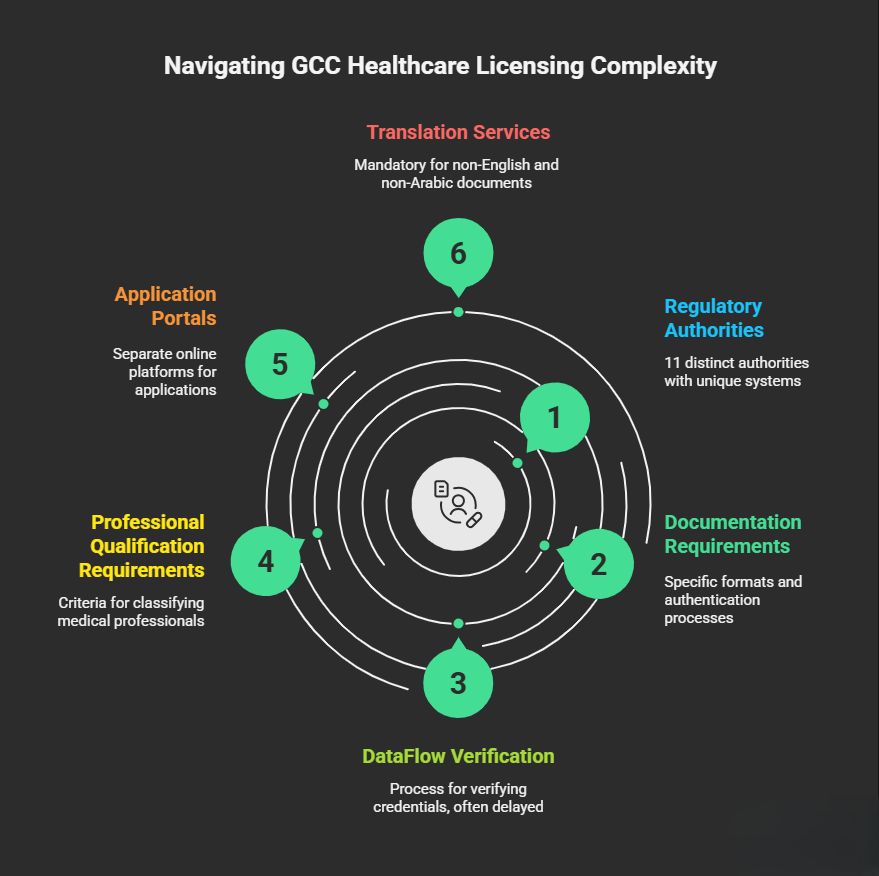
The GCC healthcare licensing landscape comprises 11 distinct regulatory authorities, each operating independent systems with unique requirements.
The UAE alone maintains six separate authorities: Dubai Health Authority (DHA), Department of Health Abu Dhabi (DOH), Ministry of Health and Prevention (MOHAP), Dubai Healthcare City Authority (DHCA), Sharjah Health Authority (SHA), and Central Department of Abu Dhabi (CDA).
Add Saudi Arabia’s SCFHS, Qatar’s QCHP, Bahrain’s NHRA, Oman MOH, and Kuwait MOH, and the complexity multiplies exponentially.
Each authority maintains distinct Professional Qualification Requirements (PQR), classification systems, and examination protocols.
For example, SCFHS divides medical qualifications into Group 1 and Group 2 classifications according to the SCFHS classification system. Group 1 certifications, including Royal College fellowships and American Board certifications, require three years of post-certification experience for consultant classification.
Group 2 certifications demand five years of post-certification experience for equivalent consultant status. Misunderstanding these distinctions results in rejected applications, extended delays, and frustrated practitioners.
Similarly, DHA, DOH, and MOHAP each utilize separate application portals, documentation requirements, and processing timelines despite all operating within the UAE.
A licensing coordinator must master the Healthcare Professional Registration System (HPRS) for DHA, TAMM portal for DOH, and MOHAP’s distinct platform, while tracking which certificates require UAE PASS authentication, Ministry of Justice translation, or specific attestation procedures.
DataFlow Verification: The Black Hole Where Applications Disappear
Primary Source Verification through DataFlow Group represents the most common cause of licensing delays. The verification process takes 4 to 12 weeks upon submitting required certificates and fees, but processing frequently extends beyond 60 working days when issuing authorities respond slowly or documents contain discrepancies.
Common rejection triggers include name mismatches between passports and educational certificates, incomplete or missing experience letters, unverified institutional addresses, and improper certification formats.
In the UAE specifically, attested documents are mandatory for DataFlow verification. Submitting unverified degree certificates or experience letters leads to verification delays or negative reports.
The most severe outcome is a “Non-Genuine” classification. One “Non-Genuine” tag from DataFlow blocks practitioners across ALL GCC authorities according to verification guidelines, potentially ending a healthcare professional’s entire Gulf career before it begins.
This single mistake, often resulting from insufficient understanding of verification requirements, carries permanent consequences that no amount of future documentation can reverse.
Generic HR departments typically lack the specialized knowledge to prevent these failures. They don’t understand that experience letters must include exact employment dates, designation, full institutional name, official stamp, contact details including phone and email, and physical address.
They aren’t aware that issuing authorities must be reachable and cooperative, or that certificate names, dates, and signatures must precisely match official records.
The Documentation Maze That Frustrates HR Departments
Beyond DataFlow complexity, each GCC authority demands specific documentation formats. SCFHS requires educational credentials authenticated by the Saudi Cultural Mission or Bureau in the applicant’s home country, with all certificates and experience letters translated into English.
Surgical specialties require logbooks covering the last two years with hospital stamps and Medical Director signatures.
General practitioners need employment certificates from each current and past employer confirming job title and employment period, with a minimum of two years of specialty experience mandatory.
DHA’s system requires different documentation emphases. MOH-approved translation services become mandatory for non-English and non-Arabic documents.
The Unified Healthcare Professional Qualification Requirements guide determines eligibility for General Practitioner, Specialist, or Consultant classifications, but these requirements differ from SCFHS classifications despite both evaluating similar credentials.
Without dedicated licensing professionals who track these authority-specific requirements, facilities experience repeated application returns requesting additional documentation, extending timelines by months and frustrating both employers and practitioners awaiting clearance.
The ROI of Having a Dedicated GCC Licensing Professional

Speed: From 12 Months to 90 Days
Healthcare facilities attempting DIY licensing typically spend 6 to 18 months navigating the complete process. Trial-and-error approaches, rejected applications, and multiple submission attempts compound delays.
In contrast, licensing professionals with comprehensive authority knowledge complete the same process in 30 to 90 days with first-time approvals.
The time savings translate directly to revenue. A specialist physician generating $10,000 monthly in facility revenue represents $60,000 to $150,000 in lost income during DIY licensing delays versus professional handling.
Multiply this across multiple hires during facility expansion, and the financial impact becomes substantial.
Cost Savings: Preventing $8,000-$15,000 in Mistakes
Failed DataFlow applications, multiple Prometric examination attempts, rejected professional classification submissions, and emergency consultant interventions typically cost healthcare professionals $8,000 to $15,000 when attempting licensing without professional guidance.
Facilities either absorb these costs to attract talent or pass them to practitioners, reducing competitive positioning in tight labor markets.
Dedicated licensing professionals eliminate these waste expenses. They submit accurate documentation from the outset, prevent verification rejections, ensure correct authority selection based on practitioner qualifications, and maintain compliance throughout the process.
The cost of employing or contracting a licensing professional typically represents 20-30% of the expenses incurred through failed DIY attempts.
Risk Mitigation: 98% First-Attempt Success Rate
Professional licensing specialists achieve dramatically higher success rates compared to facilities that manage licensing internally. Training programs report 98% first-attempt success rates when graduates apply systematic approaches learned through comprehensive authority training.
This success rate eliminates blacklisting risks, ensures regulatory compliance across all 11 authorities, provides continuous monitoring of regulation changes, and establishes proper documentation protocols from initial application through license renewal.
For facilities, this translates to predictable hiring timelines, reduced legal exposure, and confident workforce planning.
Your Career Opportunity: Becoming a GCC Healthcare Licensing Professional

The Market Demand Is Exploding
Healthcare expenditure in the GCC is projected to reach $159 billion by 2029, representing a 7.8% compound annual growth from 2024. Saudi Arabia leads regional expansion at 8.8% CAGR, while the UAE grows at 6.7% annually. This growth creates a massive demand for professionals who can navigate licensing complexity.
The infrastructure expansion is equally dramatic. The GCC requires 12,317 additional hospital beds by 2029, with Saudi Arabia accounting for 69% of new capacity. Each new bed represents multiple healthcare practitioners requiring licensure.
Between 2021 and April 2025, the GCC recorded nearly 400 healthcare investment transactions according to industry reports, with the UAE completing 198 deals and Saudi Arabia 170 deals.
Every new facility, every expansion, every hired practitioner creates work for licensing professionals. The mathematics are straightforward: more healthcare infrastructure requires more licensed practitioners, which requires more licensing expertise.
High Income Potential: AED 5,000-27,000+ Monthly
GCC licensing professionals command attractive compensation across multiple career paths. Full-time employment at healthcare facilities as licensing managers, coordinators, or compliance officers typically pays AED 5,000 to 15,000 monthly according to GCC salary data, depending on experience, facility size, and geographic location. Entry-level positions start around AED 5,000-7,000 monthly, while experienced coordinators earn AED 10,000-15,000.
Freelance licensing consultants serving multiple healthcare professionals and facilities earn AED 3,000 to 12,000 monthly, with income scaling based on client volume and services offered. Many successful licensing professionals combine both approaches, maintaining full-time positions while accepting select freelance clients during evenings and weekends, achieving total monthly income of AED 8,000 to 27,000.
This earning potential significantly exceeds opportunities in source countries. US licensing coordinators earn $41,000 to $60,000 annually, equivalent to $3,400-$5,000 monthly—substantially lower than GCC compensation for similar work.
Multiple Career Paths Available
Licensing professionals pursue diverse career trajectories. Hospital and clinic licensing managers oversee all practitioner licensing for facilities, coordinating applications, maintaining compliance, and liaising with authorities.
Healthcare HR specialists focus specifically on licensing divisions within larger healthcare systems. Compliance officers ensure facilities meet all regulatory requirements, including licensing standards.
Independent licensing consultants build client bases of individual healthcare practitioners seeking GCC licensure, offering end-to-end services from initial consultation through license issuance.
Agency owners scale this model, employing multiple consultants to serve larger client volumes. Each path offers distinct advantages in autonomy, income potential, and work-life balance.
90-Day Path to This High-Demand Career
Comprehensive training programs provide structured pathways into this profession. Effective training covers all 11 GCC authorities—DHA, DOH, MOHAP, DHCA, SHA, CDA, SCFHS, QCHP, NHRA, Oman MOH, and Kuwait MOH—with authority-specific requirements, application procedures, and documentation standards for each.
Training includes mastery of DataFlow verification processes, understanding of Primary Source Verification requirements, professional classification frameworks across authorities, examination systems including Prometric, and documentation template creation.
Structured 90-day programs enable career entry regardless of prior healthcare background, with graduates securing roles or consulting clients typically within three months of completion. The investment—while substantial—pays returns through saved errors, faster career entry, and higher earning potential compared to self-taught approaches.
Frequently Asked Questions
Q1: Do I need a medical background to become a licensing professional?
No, you don’t need a medical degree. Successful licensing professionals come from backgrounds in HR, administration, business, or as career changers from entirely different fields.
The key competencies are mastering regulatory frameworks, understanding documentation requirements, and navigating verification processes across GCC authorities.
Comprehensive training programs cover everything necessary, regardless of starting background, teaching authority-specific requirements, DataFlow verification protocols, examination systems, and professional classification criteria through structured modules.
Q2: How long does it take to become proficient in GCC healthcare licensing?
With structured training, you can become proficient in 90 days. This timeframe includes learning all 11 GCC authority requirements, DataFlow verification processes, Prometric and oral examination systems, documentation standards, and professional classification frameworks.
Many graduates secure their first licensing role or consulting client within three months of completing training, applying learned knowledge immediately to real-world applications. Self-taught approaches typically require 12-18 months to achieve comparable proficiency through trial and error.
Q3: Can I work as a licensing professional remotely or do I need to be in the GCC?
Both options remain viable. Many licensing professionals work remotely from India, Pakistan, the Philippines, or other countries, serving GCC healthcare facilities and practitioners through digital communication. Online coordination handles most licensing tasks, with practitioners managing in-person requirements in their destination countries.
However, being based in the GCC offers advantages for full-time positions at hospitals and clinics, with salaries ranging from AED 5,000-15,000 monthly plus benefits, visa sponsorship, and career advancement opportunities within healthcare systems.
Q4: What’s the difference between working full-time versus freelancing as a licensing consultant?
Full-time positions offer stability, consistent income, employee benefits, visa sponsorship, and professional development within established healthcare organizations. Salaries range from AED 5,000-15,000 monthly, depending on experience and facility.
Freelance consulting provides flexibility, the ability to serve multiple clients, income scaling potential, and work-life balance customization. Freelancers earn AED 3,000-12,000 monthly based on client volume.
Many professionals combine approaches, maintaining full-time employment while accepting select freelance projects, achieving a combined income of AED 8,000-27,000 monthly with diversified revenue streams.
Q5: How do healthcare facilities find and hire licensing professionals?
Facilities hire through multiple channels, including healthcare recruitment agencies specializing in administrative and compliance roles, LinkedIn professional networking and direct outreach, company career portals and job boards, and referrals from regulatory consultancies and industry connections.
Having comprehensive training in all 11 GCC authorities signals competency to employers. Demonstrated success with DataFlow verification, understanding of authority-specific requirements, and proven track record with successful applications make candidates highly attractive.
Certification from recognized training programs significantly increases hiring prospects, as facilities value verified competency over self-reported knowledge.
Launch Your High-Income GCC Healthcare Licensing Career Today
The GCC healthcare sector’s explosive growth creates unprecedented demand for licensing professionals who can navigate complex regulatory requirements across 11 distinct authorities. With $159 billion in healthcare expenditure by 2029, 12,317 new hospital beds required, and hundreds of facility expansion projects underway, the need for licensing expertise will only intensify.
This represents your opportunity to enter a high-income, in-demand profession with earning potential from AED 5,000 to 27,000 monthly. Whether you seek full-time stability at a healthcare facility, freelance consulting flexibility, or a combined approach that maximizes your income, the pathway begins with comprehensive training in GCC healthcare licensing frameworks.
Download our comprehensive GCC Healthcare Licensing Training brochure to discover the complete 90-day program covering all 11 authorities, DataFlow mastery, professional classification systems, examination preparation, and career launch strategies. Join 2,000+ professionals who’ve successfully transitioned to this career through proven training that eliminates trial-and-error costs and accelerates your path to licensing expertise.
With 7+ years of proven results, 98% first-attempt success rates, and comprehensive support from application through license issuance, you’ll gain the confidence and competency to serve healthcare facilities and practitioners across the Gulf region. The GCC healthcare market won’t wait—position yourself now to capture this remarkable career opportunity.